
The Nguyen Dynasty is a dynasty that highly values traditional cultural values, especially rituals and ceremonies in the royal palace. Always promoting Buddhism and Confucianism, the Nguyen kings paid special attention to the construction of pagodas and shrines to worship ancestors. Contemporary society always promotes "filial piety, respect, courtesy, and righteousness" and takes it as a standard of behavior. To serve the rituals and ceremonies at the royal court, many objects were selected and produced specifically at the royal workshop by skilled craftsmen.
After the fall of Hue Citadel in July 1885, many precious antiques of the Nguyen Dynasty were lost abroad in many different ways. After decades of "silence", many Nguyen Dynasty treasures have appeared in museums and auctions in Europe.
For example, we can take the gold purification basin, very delicately carved, which, according to priest Siefert's notes, may be aamong the treasures taken by the French from the temple worshiping the Nguyen kings in the Hue Citadel. Later, antique dealer Roger Keverne (London) bought it and displayed it at his exhibition, in the winter of 2008. This is one of the immeasurable losses for those who care and love Vietnamese antiques in general and Nguyen Dynasty treasures in particular.
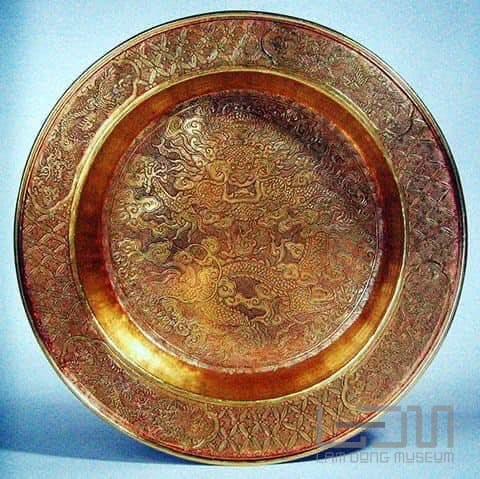
In Vietnam during the "Royal Dynasty" period (1949 - 1955), fortunately, some Nguyen Dynasty treasures were moved from Hue to Da Lat. Currently, Lam Dong Provincial Museum is preserving and promoting the value of these treasures. Among them are jade pots covered with gold and lotus stems used to serve the spiritual needs of the royal family of the Nguyen Dynasty.
Jade pot covered with gold
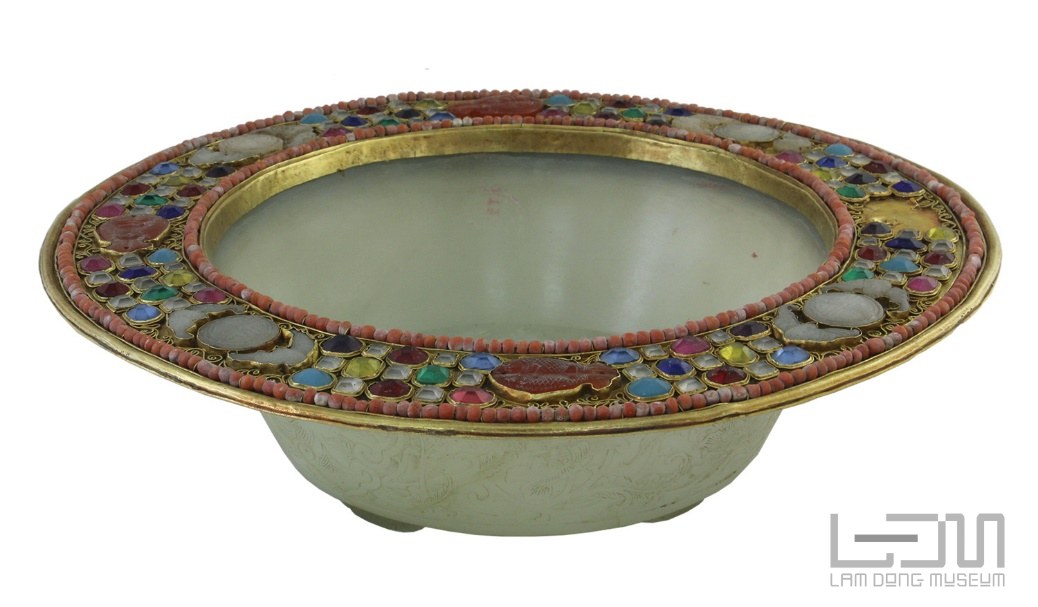
A jade basin (also known as a purifying basin) is an object for the king to wash his hands and purify himself when celebrating royal ceremonies, especially on sacrificial occasions.ceremony. This is one of the very rare items that only appears in the lives of emperors.
The basin has a wide rim, horizontal flare, beveled walls, and flat bottom. The inside of the pot is embossed with chrysanthemum branches - one of the four precious flowers (Tung - Chrysanthemum - Bamboo - Apricot), a symbol of longevity, luck, abundant blessings, as well as the spirit of a gentleman. Both the top and bottom of the pot rim are covered with thin gold plates. The top of the mouth is decorated with two frills made of pink beads. The inside of the border is decorated with precious stones shaped like 4 pairs of fish, representing luck and prosperity; Four pairs of bats flank the word longevity, implicitly representing the "five blessings" (Phuc - Loc - Tho - Khang - Ninh). Interspersed are colorful gemstones, jade, and coral, very delicately crafted.
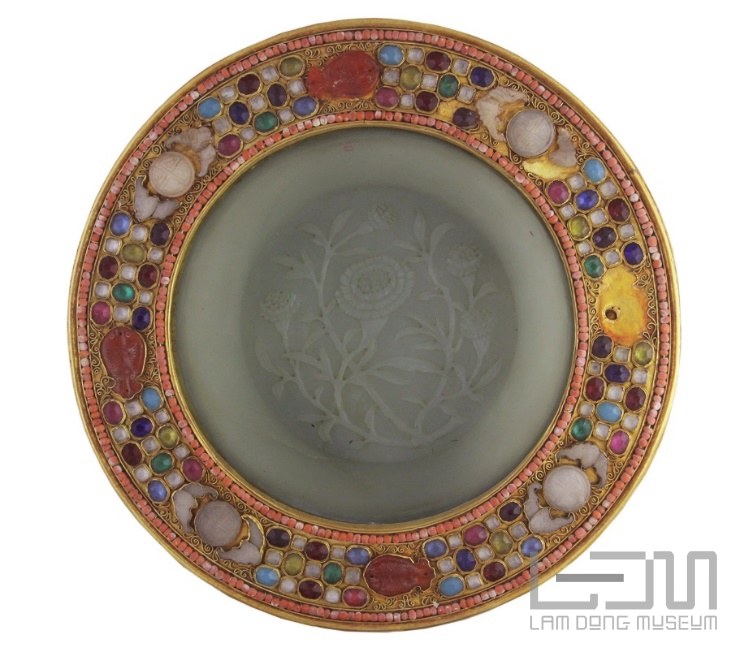
(The underside of the mouth is engraved with some small Chinese characters: “Eight five years of gold, total weight is ten seven taels, one amount is seven divisions” (Eight and a half year old gold, total seventeen taels, one is just sevendivision).
Lotus
From India, China, Japan to Vietnam, the lotus flower carries profound and sacred meanings. The lotus is revered in Indian culture as a symbol of creation and rebirth, originating from the story of Brahma being born from a lotus growing from the navel of Vishnu while he was lying on the surface of the cosmic sea. In China, the lotus flower is associated with the image of Avalokiteshvara in Buddhism, who brings compassion and love to sentient beings. In Japan, the lotus flower is called “Hasu”, which plays an important role in culture and religion.
In Vietnamese culture, the lotus is considered a symbol of purity, nobility, kindness, resilience and determination to rise. In Vietnamese life, lotus has many uses in health, beauty, feng shui and cuisine: lotus heart, lotus pistil, lotus seed, lotus leaf are used to support sedation, relieve pain, reduce inflammation, control blood sugar, support the heart and stop bleeding; essential oils and lotus petals help nourish the skin, fight aging and soothe the mind; Lotus roots, lotus seeds, and lotus roots are ingredients for many dishesdelicious and nutritious... In feng shui, the lotus flower is also considered a symbol that brings luck and peace. In Vietnamese decorative arts, with the skillful hands of artisans, lotus images often appear in architectural decorations, household utensils, altar objects, and royal objects.
At the Lam Dong Provincial Museum, there are many Nguyen Dynasty royal artifacts related to the lotus image, such as the statue of Bodhisattva Avalokiteśvara sitting on a lotus; shower mirror (paperweight); Lotus leaf-shaped inkstone; The altar's top is carved with stylized lotus flowers and a lotus stem. In particular, the lotus flower is an object of worship or a place to place small offerings when performing rituals.
According to Buddhist concepts, the formation of the lotus flower takes place according to the law of cause and effect and reincarnation. The blooming flower symbolizes the past, the lotus stem symbolizes the present and the lotus seed symbolizes the future, continuity. Besides, the lotus stem also symbolizes the fruit of merit. As soon as it flowers, the lotus mirror symbolizes and begins to bear seeds, just like when the practitioner has just developed the Bodhi mind, the merit begins to sprout. From then on, the lotus placed on the worship space has both spiritual and symbolic meaningHigh aesthetics, showing devotion and respect for ancestors.
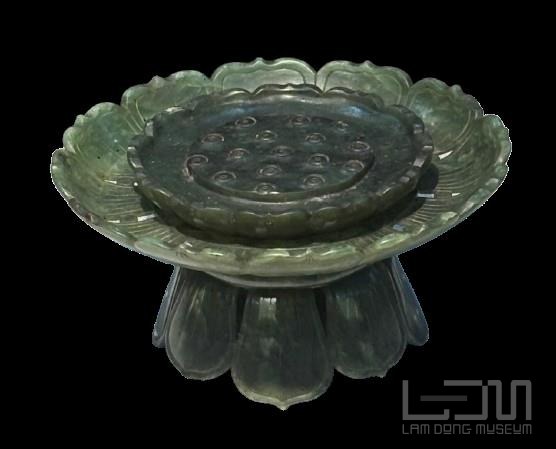
The lotus stem artifact is made from jade stone, with an uneven green color. The lotus stem is carved in the shape of a blooming lotus flower. The outermost ring is shaped like 12 lotus petals, 10.9cm in diameter. The second ring inside has 12 lotus petals, 7.2cm in diameter. In the middle is a shower mirror with a diameter of 4.4cm. The base of the lotus base is carved into 8 lotus petals of similar size and connected together.
The lotus stem is crafted with 12 petals reminiscent of the 12 great vows of the Medicine Buddha to save sentient beings, while the 8 lotus petals at the base symbolize the Noble Eightfold Path (eight righteous paths). Besides, 8 lotus petals also symbolize eight precious virtues of practitioners (purity, innocence, patience, clearness, contentment, emptiness, direct action, and nourishment).
Jade pots and lotus stands are not only items serving ceremonies in the Nguyen Dynasty's royal court but are also unique artifacts.unique and a living testament to the sophisticated level of craftsmanship. Through every carved detail, rare materials and special uses, these two artifacts clearly demonstrate the concept of rituals, respect for ancestors and the spirit of upholding the moral "When drinking water, remember the source" of the nation. These artifacts not only have historical and aesthetic value, but also contribute to deeply portraying the cultural identity of Vietnamese royal court.
Pham Thi Ngat
REFERENCES
1. Enlightenment Online Newspaper (2010), Wonderful Meaning of Lotus in Buddhism.
2. Lam Dong Museum (2019), Royal treasures of the Nguyen Dynasty at Lam Dong Museum.
3. Dinh Quynh Hoa (2016), About the Four Noble Paintings: Tung - Cuc - Truc - Apricot.
4. Philippe Truong - Tran Duc Anh Son (2010), Treasures of the Nguyen Dynasty in Europe.